

 LinkedIn
Most advice on getting cited in Google’s AI answers belongs to 2023. It assumes a top-ten ranking is your ticket into the answer. The shifts since then tell a less comfortable story: a page can rank well without being cited, and a useful passage can be cited without ranking well.
Ask three consultants how to get your website cited in Google’s AI Overviews, and you may get three playbooks. One wants a 45-word definition under every H2. Another wants backlinks to push your page into the top five. A third wants schema markup and patience. These tactics come from different moments in search history, but agency decks tend to present them as one timeless checklist.
I would date the playbook before paying for it. Here is what each turning point rewarded, what it broke, and what I would throw out now.
2014–2017: Featured snippets reward the detachable answer
When Google introduced featured snippets in 2014, the answer box largely worked by extracting text from a page rather than composing a new answer. A concise passage could appear above the standard results, while the originating URL could also appear among the organic links below. Marketers called that top box position zero. Two placements for one page made the tactic hard to ignore.
The practical response was to make answers easy to lift. An explicit question heading followed by a short, self-contained paragraph gave Google a passage it could show without dragging the rest of the article into the box. Lists and tables served similar purposes when the query called for steps or comparisons. The page still had to be worth finding, but the answer had to make sense on its own.
That incentive shaped years of copy: exact-match headings, definitions written to fit the box, and openings stripped of caveats. It also left a habit that survived long after its original purpose: treating every H2 as a slot for a robotic 45-word summary. A direct answer is useful. Writing an entire site as if Google is still filling one clipping box is not.
What broke for practitioners: a good ranking alone did not guarantee the featured snippet. The passage had to answer the query cleanly enough to be extracted. Keep that lesson; leave the rigid word-count ritual behind.
January 2020: Featured snippets lose the second organic placement
On January 22, 2020, Google began deduplicating featured-snippet URLs from page-one organic results. A URL in the snippet box would no longer get a second listing among the regular page-one results. Position zero still offered prominent placement, but the old two-listings-for-one-query pitch no longer held.
That matters because the snippet playbook had two distinct promises. One was that answer-shaped text could win a prominent extraction. The other was that winning it would give the same page twice the top-of-page real estate. The first lesson survived; the second did not.
I would be wary of any audit that still sells snippet formatting as an automatic traffic multiplier. Ask which benefit it expects: an answer placement, a second organic listing, or a citation in a generated response. Those are different outcomes. If the deck treats them as interchangeable, you know roughly when it was last updated.
February 2021: Passage ranking gives sections more weight
A long page can contain one unusually useful answer. Historically, a page’s broad topic could make that narrow answer harder to surface for a specific query. On February 10, 2021, Google rolled out passage ranking for English queries in the US. The change improved its ability to identify a relevant passage within a longer page when ranking the page.
For practitioners, that weakened the case for spinning every related question into a separate thin URL. A comprehensive resource could contain sections that answered narrower questions, provided those sections actually did the work. A useful section became more important than another URL built around a keyword variation.
It did not follow that every article should become a 6,000-word encyclopedia. Padding a page with history, repeated definitions, and generic introductions gives readers more to wade through without making the relevant passage better. The useful change was structural: put the specific answer where a reader can find it, support it with the necessary detail, and cut the rest. Word count is not the mechanism.
This is where the later AI-citation argument starts to take shape. The page remains important, but the section that answers a particular question deserves its own attention. If you cannot point to that section in your content, commissioning more pages may only multiply the problem.
May 2023: SGE tests the rank-first assumption
When Google unveiled Search Generative Experience, or SGE, in Search Labs in May 2023, a comforting theory took hold: the generative answer would mostly draw from the same winners as the organic results below it. Under that theory, the job was familiar. Build links, defend a top-three position, and wait for the citation.
The early measurements gave teams reason to test that assumption rather than build a budget around it. When Authoritas analyzed 1,000 commercial queries in SGE, it found that 62% of generative citation links came from domains outside the organic top 10. Only 4.5% of generative URLs directly matched a page-one organic URL. The generative module also pushed the leading organic result substantially farther down the screen.
That study did not mean rankings had stopped mattering. It meant a top-ten ranking was not a reliable substitute for measuring whether a page appeared as a source. The distinction sounds obvious now. In 2023, plenty of plans still treated citation visibility as a bonus that would arrive with better organic positions.
What broke for practitioners: “we rank, therefore we will be cited” was no longer a sound forecast. If an agency still reports only positions while promising AI-answer visibility, it is measuring the old objective and assuming the new one followed.
May 2024: AI Overviews bring the citation gap into the open
Google rolled out AI Overviews to all US users in May 2024. The question moved from what might happen in Search Labs to what appeared on a live results page. Later measurement put numbers on the gap between organic rank and citation.
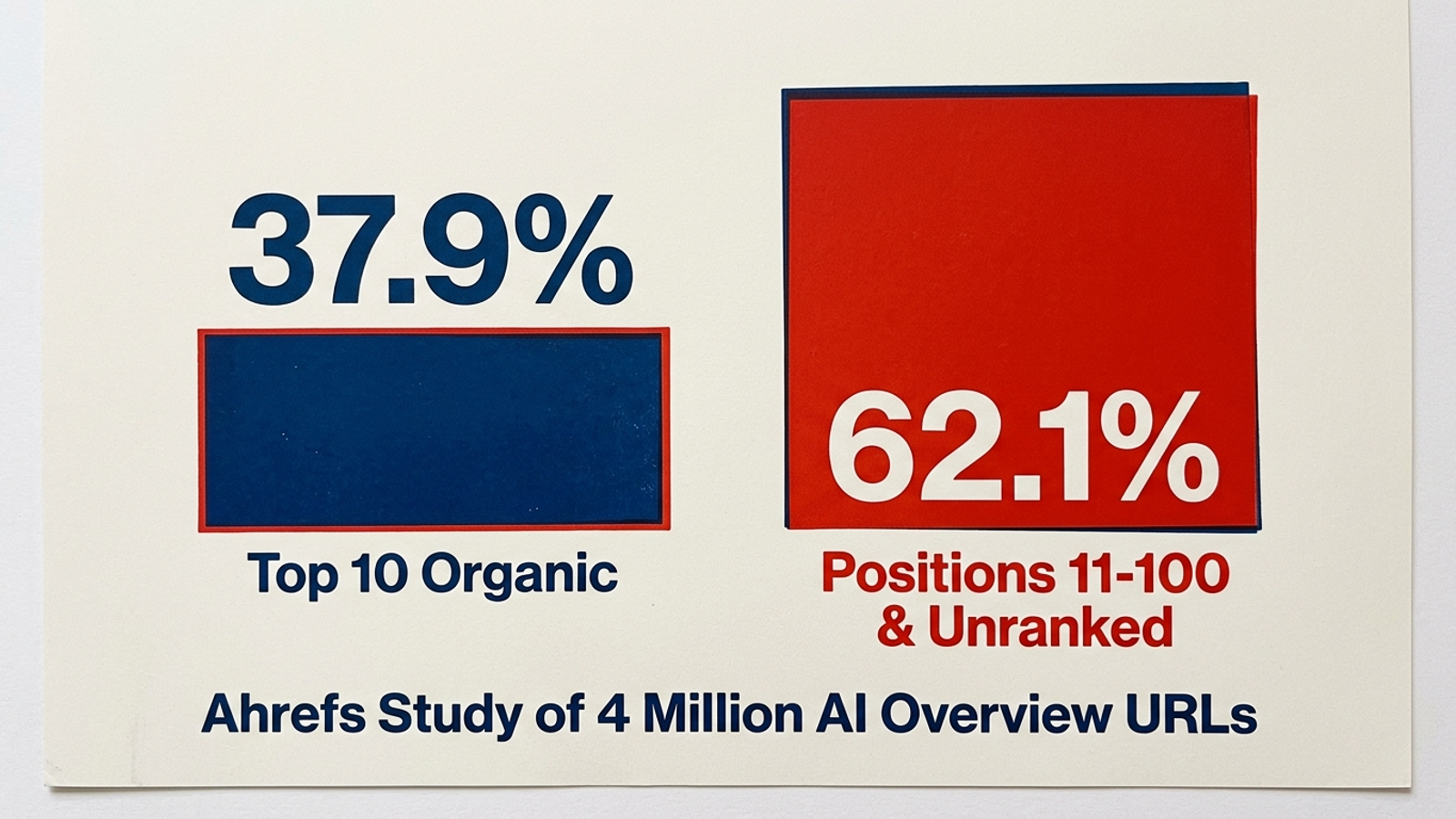
In an analysis of 863,000 search results and four million cited URLs, Ahrefs found that 37.9% of AI Overview citations ranked in the organic top 10. Another 31.2% ranked between positions 11 and 100, while 31.0% did not rank in the top 100. Those figures do not make organic SEO obsolete. They make it difficult to claim that pushing a page from position four to position two will, by itself, capture the AI Overview.
BrightEdge tracking across nine commercial industries found 16.7% overlap between AI Overview citations and the organic top 10. The studies use different samples and measurements, so I would not pretend they give one universal citation rate. Their shared practical point is enough: rank and citation are different things to track.
That changes what a content review should inspect. A ranking report tells you where a URL appears in conventional search. It does not tell you whether the page answers the particular question an AI response cites, whether that answer is easy to find, or whether a more specific page elsewhere is doing the job better. A polished guide can rank while a narrower, clearer explanation gets the citation.
What broke for practitioners: the rank tracker stopped being a complete visibility report. Keep tracking positions, but do not use them as evidence that your citation strategy is working.
October 2024: Ads enter AI Overviews
On October 3, 2024, Google rolled out ads in AI Overviews for US mobile searches, including sponsored Search and Shopping placements. Anyone expecting generative results to remain an ad-free corner of Google had overlooked the business model.
For a search team, this made the new page harder to manage with separate, blinkered reports. A cited source and a sponsored placement are not the same thing: one depends on the answer’s sources, the other on an ad auction. But both can affect what a searcher sees around an AI-generated response. Do not call paid placement a citation, and do not ignore paid placement when assessing visibility.
The rollout did not prove that buying an ad could replace useful source material. Nor did it prove that a citation would eliminate the need for paid search. It broke the simpler assumption that AI answers sat outside the commercial search operation. If the paid team and the organic team report in different rooms, someone still has to put the full results page back together.
May 2025: AI Mode makes the hidden sub-question matter
On May 20, 2025, Google unveiled AI Mode at Google I/O. Its query fan-out approach breaks a complex prompt into multiple background searches; the account linked here describes 5 to 11 sub-queries. The searcher sees one question. The system can explore several parts of it before composing an answer.
That changes the publishing problem. A page optimized around the headline phrase may cover the broad intent while skipping the comparison, constraint, or edge case that one of those background searches pursues. A more specific source can then supply the missing piece. The question you did not put in your keyword brief may be the one that picks the citation.
In a comparison of 730,000 response pairs, AI Overviews and AI Mode produced answers with 86% semantic similarity but shared only 13.7% of cited sources. Similar-looking answers, in other words, did not necessarily rely on the same URLs. That is a poor foundation for any promise that one ranking, one page format, or one citation report covers every Google AI surface.
What broke for practitioners: single-keyword intent matching became an even thinner content brief. Before commissioning another broad guide, list the concrete follow-up questions a buyer would ask: technical limits, pricing boundaries, alternatives, and the cases where the usual answer fails. Then check whether the page answers them directly. Fan-out gives a useful reason to do that work; it is not a reason to publish endless thin pages.
Present: Date the playbook before you fund it
The line through this timeline is not that rankings died. It is that rank alone became a weaker explanation for who gets quoted. Featured snippets rewarded detachable answers. Passage ranking made useful sections easier to surface. SGE and AI Overviews showed that cited sources did not reliably mirror the organic top 10. AI Mode added background questions that a headline-keyword page might never answer.
Here is the short audit I would run before approving another search retainer:
- Ask what it measures. If the report promises AI citations but shows only organic positions, it has not measured the promise.
- Inspect the actual answers. Look for specific claims, constraints, comparisons, and caveats. Replace padded introductions and vague marketing copy with information a reader can use.
- Check whether that information can be fetched. Important text should not be buried behind a difficult page experience or treated as an afterthought to the design.
- Ask who makes the changes. A citation alert is only a notification if nobody updates the page.
That last point is why I separate tools that help a business get featured in Google AI Overviews from tools that only monitor appearances. A dashboard can tell you a competitor replaced you in an answer. It cannot, by itself, identify the missing sub-question, improve the page, and get the change published. Three weeks later, the chart may be immaculate. The page is still wrong.
At groas, we built a fully autonomous growth engine around that execution gap. Specialized AI models work across paid and organic search, identifying citation gaps, deploying factual content, addressing crawl hurdles, and managing paid-search bids within client-defined guardrails. A named human strategist sets direction and owns accountability. The point is not to make another dashboard for a busy owner to interpret. It is to turn search work into action tied to commercial outcomes.
My reading of the next turn is straightforward: more of the valuable work will happen at the level of the specific answer, while the business still needs to judge the whole search result against revenue. If your agency’s AI-citation plan begins and ends with “rank in the top ten,” you know which year its playbook comes from. Stop buying the 2023 edition.